Intelligence Fundamentals: From Raw Data to Actionable Intelligence
TL;DR
Intelligence is not just data collection—it’s the systematic transformation of raw information into actionable insights that drive decision-making. This foundational piece covers:
- The DIKW Pyramid: Data → Information → Knowledge → Wisdom progression
- Intelligence Levels: Strategic, Operational, and Tactical distinctions
- Collection Disciplines (INTs): HUMINT, SIGINT, OSINT, GEOINT, MASINT, FININT
- The Intelligence Cycle: A continuous 6-phase process from requirements to feedback
- Source Evaluation: The Admiralty System for rating reliability and credibility
- Cognitive Biases: The silent killers of good intelligence analysis
- Attribution Challenges: Why “whodunit” is harder than it looks
- Application to Cyber Threat Intelligence (CTI): How traditional intelligence concepts map to modern threat detection
What is Intelligence?
Intelligence is frequently misunderstood. It is not merely the accumulation of facts, nor is it synonymous with data or information. Intelligence represents the refined product of a rigorous analytical process—the transformation of disparate data points into coherent, contextual understanding that enables informed decision-making.
“Intelligence is information that has been collected, integrated, evaluated, analyzed, and interpreted.” — Joint Publication 2-0, Joint Intelligence
The distinction matters. A sensor detecting network traffic produces data. When that data is parsed and correlated, it becomes information. When an analyst determines the traffic pattern matches known command-and-control behavior, it becomes knowledge. When leadership uses that knowledge to authorize defensive measures or attribute the activity to a specific threat actor, we approach wisdom.
Critical Point: Intelligence is not truth—it is an estimate of truth based on incomplete information. Every intelligence product carries inherent uncertainty, which is why confidence levels and source evaluation are fundamental to the discipline.
The DIKW Pyramid: From Noise to Insight
The Data-Information-Knowledge-Wisdom (DIKW) hierarchy provides a foundational framework for understanding how raw inputs transform into actionable intelligence.
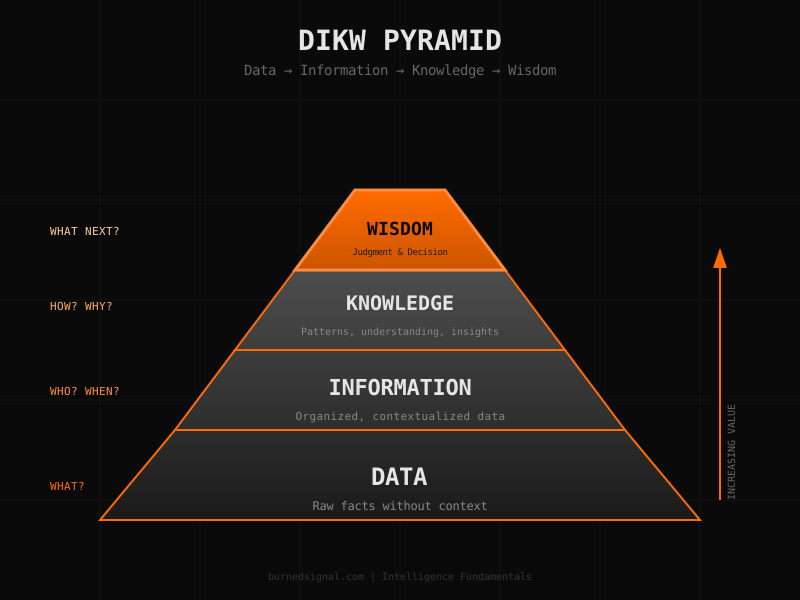
Data (What?)
Raw, unprocessed facts without context. In cyber operations, this includes:
- Packet captures
- Log entries
- File hashes
- IP addresses
- DNS queries
Data alone answers “What happened?” but provides no meaning.
Example: 192.168.1.105 connected to 45.33.32.156:443 at 03:42:17 UTC
Information (Who, When, Where?)
Data becomes information when organized, structured, and given context. Information answers basic interrogatives.
Example: “Workstation WS-105, assigned to user john.doe in the Finance department, established an encrypted connection to an IP address geolocated to St. Petersburg, Russia, during non-business hours.”
Knowledge (How? Why?)
Knowledge emerges from analyzing patterns, correlating multiple information sources, and applying expertise. It provides understanding of mechanisms and motivations.
Example: “This connection pattern matches known Cobalt Strike beacon behavior. The destination IP is associated with infrastructure previously attributed to APT29. The Finance department has access to sensitive M&A documentation. This likely represents initial access by a sophisticated threat actor conducting economic espionage.”
Wisdom (What Should We Do?)
Wisdom synthesizes knowledge with experience, ethical considerations, and strategic context to inform decisions. It enables foresight and optimal action selection.
Example: “Based on the attribution confidence level (MODERATE), potential business impact, and geopolitical context, we recommend: (1) immediate network isolation of affected systems, (2) engagement of incident response, (3) notification of legal counsel regarding potential nation-state involvement, and (4) coordination with sector ISAC partners who may face similar targeting.”
The Four Qualities of Actionable Intelligence
Not all intelligence is created equal. Effective intelligence exhibits four critical characteristics:
| Quality | Definition | Counter-Example |
|---|---|---|
| Actionable | Enables specific decisions or actions | “Bad actors exist on the internet” |
| Timely | Delivered when it can still influence outcomes | Attribution report arriving 6 months post-breach |
| Relevant | Addresses the consumer’s specific requirements | Sending ICS/SCADA threat intel to a SaaS company |
| Accurate | Factually correct with appropriate confidence levels | Misattributing commodity malware to an APT |
The acronym ATRA (Actionable, Timely, Relevant, Accurate) provides a useful mnemonic for evaluating intelligence quality.
Source Evaluation: The Admiralty System
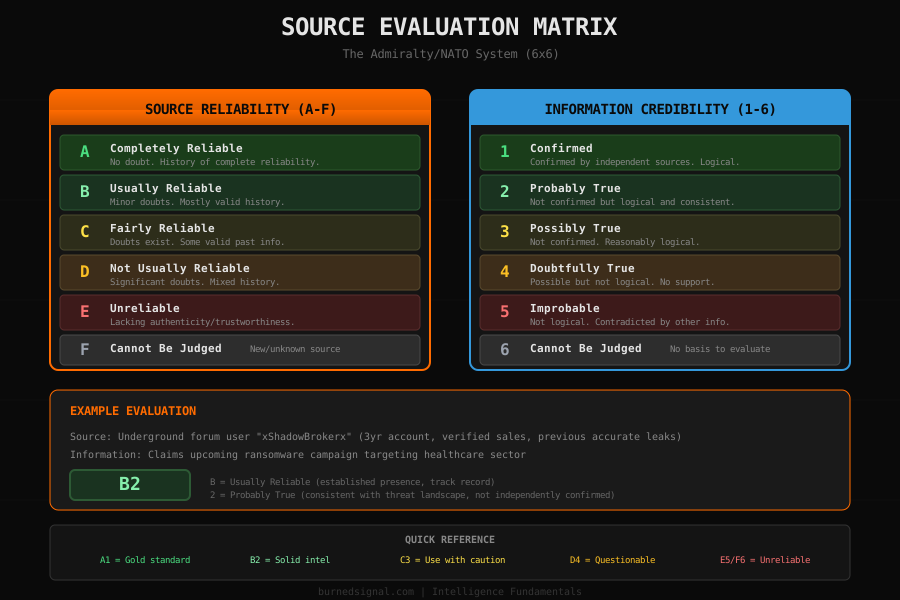
Before any information becomes intelligence, it must be evaluated. The intelligence community uses standardized grading systems to assess both the reliability of the source and the credibility of the information.
The Admiralty/NATO System
This dual-axis evaluation system, also known as the “6x6 system” or “NATO System,” has been the standard since WWII:
Source Reliability (A-F)
| Grade | Description | Criteria |
|---|---|---|
| A | Completely Reliable | No doubt about source’s authenticity, trustworthiness, and competence. History of complete reliability. |
| B | Usually Reliable | Minor doubts. History of mostly valid information. |
| C | Fairly Reliable | Doubts exist. Has provided valid information in the past. |
| D | Not Usually Reliable | Significant doubts. History of some valid, some invalid information. |
| E | Unreliable | Lacking authenticity, trustworthiness, or competence. History of invalid information. |
| F | Cannot Be Judged | No basis for evaluating reliability. New or unknown source. |
Information Credibility (1-6)
| Grade | Description | Criteria |
|---|---|---|
| 1 | Confirmed | Confirmed by independent sources. Logical, consistent with other information. |
| 2 | Probably True | Not confirmed, but logical and consistent with other information. |
| 3 | Possibly True | Not confirmed. Reasonably logical but limited corroboration. |
| 4 | Doubtfully True | Not confirmed. Possible but not logical. No other information to support. |
| 5 | Improbable | Not confirmed. Not logical. Contradicted by other information. |
| 6 | Cannot Be Judged | No basis for evaluating credibility. |
Practical Application
Example Evaluation:
Source: Underground forum user "xShadowBrokerx" (active 3 years,
        verified sales history, previous accurate leaks)
Information: Claims upcoming ransomware campaign targeting healthcare sector

Evaluation: B2
- Source Reliability: B (Usually Reliable) - Established presence, track record
- Information Credibility: 2 (Probably True) - Consistent with observed
  threat landscape, not independently confirmed
Why This Matters: Without source evaluation, you cannot assign confidence levels to your assessments. An analyst who treats a B1 source the same as an E5 source will produce garbage intelligence.
Cyber-Specific Considerations
In CTI, source evaluation extends to:
| Source Type | Reliability Factors |
|---|---|
| Threat Intel Feeds | Vendor reputation, update frequency, false positive rate |
| Dark Web Forums | Account age, reputation score, verified transactions |
| Malware Samples | Submission source, sandbox environment, analysis depth |
| OSINT | Publication credibility, author expertise, corroboration |
| Technical Indicators | Collection method, age, context |
Cognitive Biases: The Silent Killers
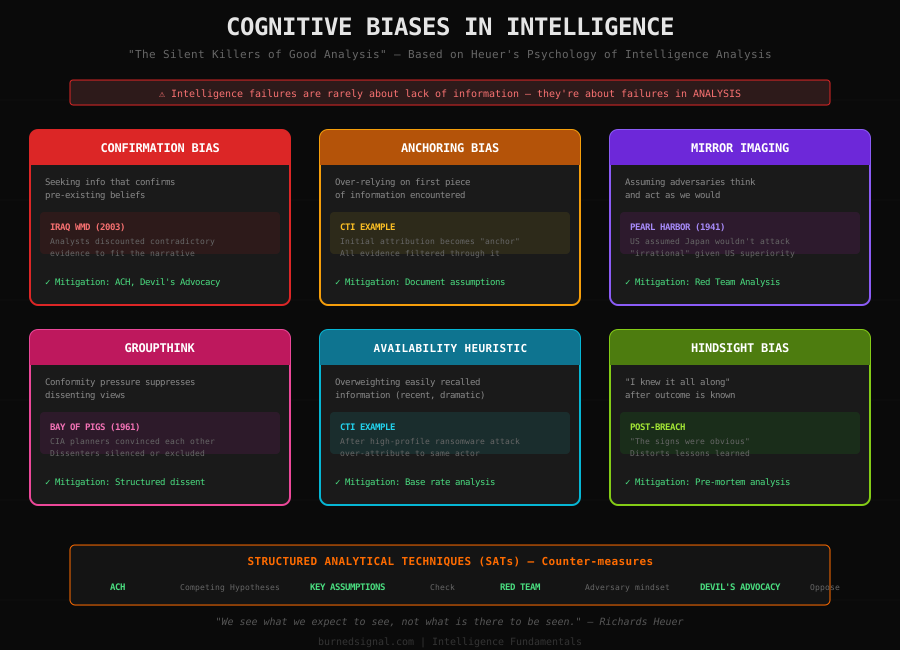
Intelligence failures are rarely about lack of information—they’re about failures in analysis. Cognitive biases are systematic errors in thinking that affect decisions and judgments.
“We see what we expect to see, not what is there to be seen.” — Richards Heuer, Psychology of Intelligence Analysis
Critical Biases for Intelligence Analysts
Confirmation Bias
Definition: Seeking, interpreting, and remembering information that confirms pre-existing beliefs.
Historical Example: Iraq WMD Assessment (2002-2003). Analysts focused on information supporting the existence of WMD programs while discounting contradictory evidence. The assumption that Saddam Hussein must have WMDs led to selective interpretation of ambiguous data.
Mitigation: Devil’s Advocacy, Analysis of Competing Hypotheses (ACH)
Anchoring Bias
Definition: Over-relying on the first piece of information encountered (the “anchor”).
Example in CTI: Initial attribution to a specific threat actor becomes the anchor. All subsequent evidence is interpreted through that lens, even when it should prompt reconsideration.
Mitigation: Explicitly document initial assumptions, revisit them regularly
Mirror Imaging
Definition: Assuming adversaries think and act as we would in their situation.
Historical Example: Pearl Harbor (1941). American analysts assumed Japan wouldn’t attack because it would be “irrational” given US military superiority. They failed to understand Japanese strategic calculus.
Mitigation: Red Team Analysis, Cultural expertise
Groupthink
Definition: Conformity pressure within a group suppresses dissenting views and alternative analysis.
Historical Example: Bay of Pigs (1961). CIA planners convinced themselves the invasion would succeed; dissenting voices were silenced or excluded.
Mitigation: Structured dissent (assigning “devil’s advocate” role), anonymous feedback
Availability Heuristic
Definition: Overweighting information that comes to mind easily (recent, dramatic, or personally experienced events).
Example in CTI: After a high-profile ransomware attack, analysts may over-attribute subsequent incidents to the same actor because that threat is top-of-mind.
Mitigation: Base rate analysis, structured checklists
Structured Analytical Techniques (SATs)
The intelligence community developed SATs specifically to counter cognitive biases:
| Technique | Purpose | Use When |
|---|---|---|
| Analysis of Competing Hypotheses (ACH) | Systematically evaluate multiple explanations against evidence | Attribution, complex assessments |
| Key Assumptions Check | Identify and examine underlying assumptions | Any major assessment |
| Red Team Analysis | Think like the adversary | Threat assessment, vulnerability analysis |
| Devil’s Advocacy | Argue against the prevailing view | Before finalizing assessments |
| Indicators & Warnings (I&W) | Define observable events that would signal change | Monitoring, forecasting |
Note: Detailed SAT methodology will be covered in Part 1 of this series.
Intelligence Levels: Strategic, Operational, Tactical
Intelligence requirements and products vary significantly based on the consumer’s decision-making horizon.
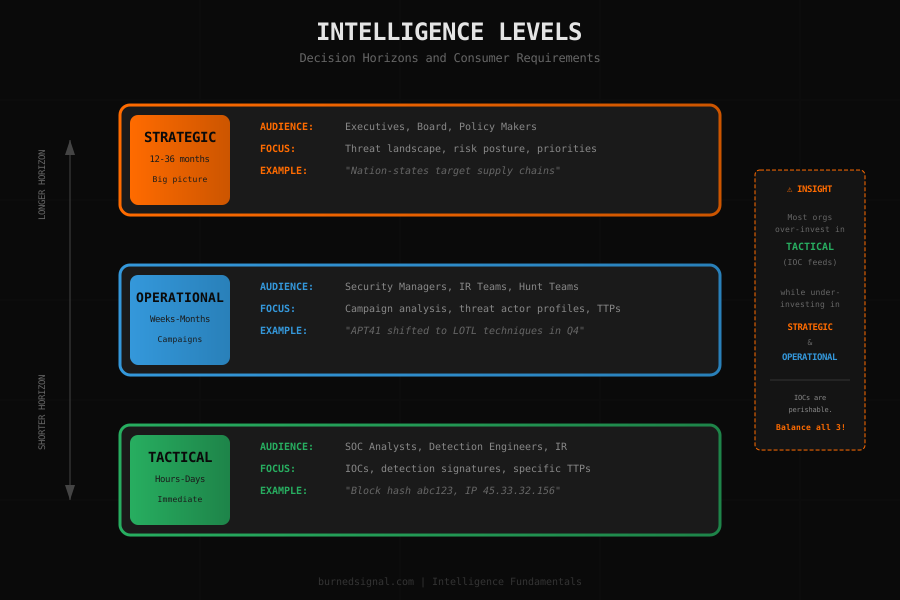
Strategic Intelligence
- Audience: Executives, Board, Policy Makers
- Horizon: 12-36 months
- Focus: Threat landscape trends, risk posture, investment priorities, geopolitical shifts
- Example: “Nation-state actors are increasingly targeting supply chains in our sector. We recommend diversifying critical vendors and implementing additional third-party risk controls.”
Operational Intelligence
- Audience: Security Managers, IR Teams, Hunt Teams
- Horizon: Weeks to months
- Focus: Campaign analysis, threat actor profiles, TTP evolution, infrastructure patterns
- Example: “APT41 has shifted from custom malware to living-off-the-land techniques in Q4. Hunt teams should prioritize detection of LOLBins abuse.”
Tactical Intelligence
- Audience: SOC Analysts, Detection Engineers, Incident Responders
- Horizon: Hours to days
- Focus: IOCs, detection signatures, specific TTPs, immediate response procedures
- Example: “Block hash
abc123..., IP45.33.32.156, and monitor for scheduled task persistence usingschtasks.exe /create.”
Critical Insight: Organizations often over-invest in tactical intelligence (IOC feeds) while under-investing in strategic and operational intelligence. IOCs are inherently perishable—they represent the artifacts of an attack, not the behavior. Mature intelligence programs balance all three levels.
Intelligence Collection Disciplines (The “INTs”)
Intelligence collection is organized into specialized disciplines, each with distinct sources, methods, and analytical requirements. These disciplines are collectively referred to as “INTs.”
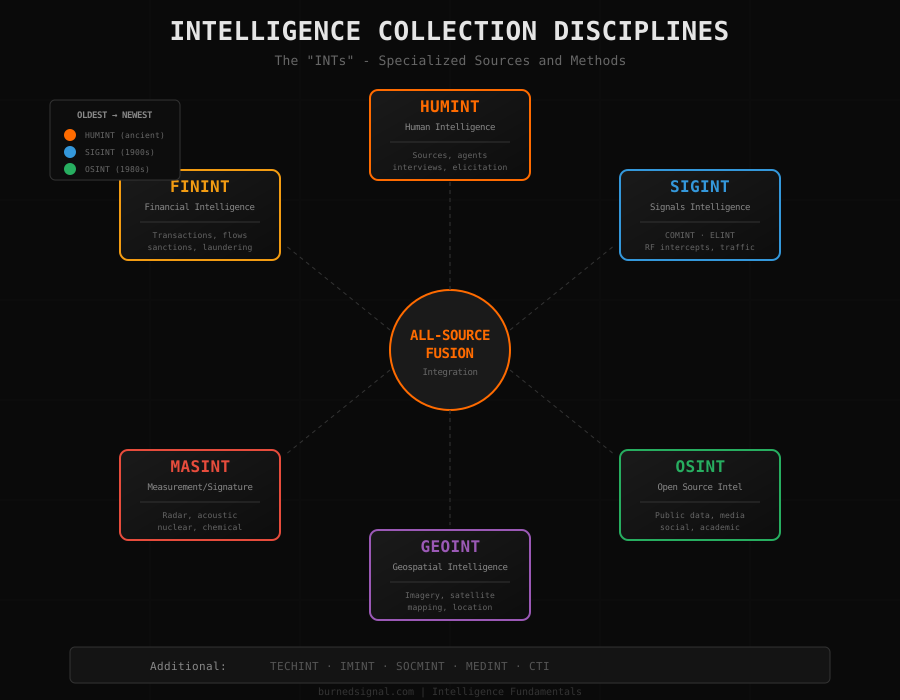
Primary Collection Disciplines
HUMINT (Human Intelligence)
Definition: Intelligence derived from human sources through interpersonal contact.
Sources:
- Informants and agents
- Diplomatic reporting
- Traveler debriefings
- Defectors
- Interrogations
- Elicitation (social engineering in cyber context)
Characteristics:
- Oldest intelligence discipline (dating to antiquity)
- Provides intent and motivation (the “why”)
- High value, high risk
- Difficult to scale
- Vulnerable to deception and double agents
Cyber Application: Engaging with threat actors in underground forums, recruiting sources within criminal organizations, social engineering assessments, insider threat programs.
Source Evaluation Challenge: Human sources can be turned, deceived, or may have their own agendas. Corroboration is essential.
SIGINT (Signals Intelligence)
Definition: Intelligence derived from the interception of signals, including communications and electronic emissions.
Sub-disciplines:
| Abbreviation | Name | Focus |
|---|---|---|
| COMINT | Communications Intelligence | Voice, text, messaging intercepts |
| ELINT | Electronic Intelligence | Non-communication signals (radar, telemetry) |
| FISINT | Foreign Instrumentation Signals Intelligence | Weapons systems, space vehicle telemetry |
Characteristics:
- Technical, scalable collection
- Volume creates analytical challenges
- Encryption is a significant obstacle
- Provides communication patterns and content
- Legal frameworks vary significantly by jurisdiction
Cyber Application: Network traffic analysis, malware C2 protocol analysis, encrypted traffic metadata analysis, passive DNS collection.
OSINT (Open Source Intelligence)
Definition: Intelligence derived from publicly available sources.
Sources:
- Media (print, broadcast, online)
- Academic publications
- Government reports and filings
- Social media
- Commercial databases
- Technical documentation
- Conference proceedings
- Court records
- Patent filings
Characteristics:
- Accessible and cost-effective
- Volume requires sophisticated filtering
- Verification challenges (misinformation, disinformation)
- Estimated to provide 60-80% of intelligence requirements
- Legal to collect, but ethical and legal considerations remain
Cyber Application: Threat actor research, vulnerability intelligence, leaked credentials monitoring, brand protection, attack surface mapping.
Legal/Ethical Considerations:
- Privacy Laws: GDPR, CCPA, and other regulations may restrict collection and processing of personal data
- Terms of Service: Scraping may violate platform ToS
- Duty of Care: Collected information may reveal individuals at risk
- Responsible Disclosure: Vulnerability information requires careful handling
GEOINT (Geospatial Intelligence)
Definition: Intelligence derived from the analysis of imagery and geospatial information.
Sources:
- Satellite imagery (optical, radar, multispectral)
- Aerial photography
- Mapping data
- Location-based services
- Geolocation metadata
Characteristics:
- Provides physical context
- Commercial availability has democratized access
- Temporal analysis reveals patterns
- Integration with other INTs enhances value
Cyber Application: Physical infrastructure mapping, data center identification, supply chain verification, attribution support (correlating physical and cyber activities).
MASINT (Measurement and Signature Intelligence)
Definition: Intelligence derived from the analysis of data obtained from sensing instruments for the purpose of identifying distinctive features associated with the source, emitter, or sender.
Focus Areas:
- Radar signatures
- Acoustic signatures
- Nuclear radiation
- Chemical/biological detection
- Spectral analysis
- Materials analysis
Characteristics:
- Highly technical
- Requires specialized sensors
- Provides unique identification capabilities
- Often complements other INTs
Cyber Application: Electromagnetic emanations analysis (TEMPEST), side-channel attacks, hardware fingerprinting.
Additional Disciplines
| INT | Full Name | Focus |
|---|---|---|
| FININT | Financial Intelligence | Monetary transactions, sanctions evasion, money laundering, cryptocurrency tracing |
| SOCMINT | Social Media Intelligence | Social platform analysis, influence operations, persona attribution |
| TECHINT | Technical Intelligence | Foreign weapons and equipment analysis, malware reverse engineering |
| IMINT | Imagery Intelligence | Subset of GEOINT focused on imagery analysis |
| MEDINT | Medical Intelligence | Health-related intelligence, biological threats, pandemic monitoring |
Note on “CYBINT”: While sometimes used colloquially, CYBINT is not a formally recognized standalone discipline. Cyber intelligence typically represents an “all-source” fusion of SIGINT, OSINT, HUMINT, and TECHINT applied to the cyber domain.
The Intelligence Cycle
The intelligence cycle describes the process by which raw information is converted into finished intelligence and delivered to consumers. While various models exist, the six-phase model is widely adopted:
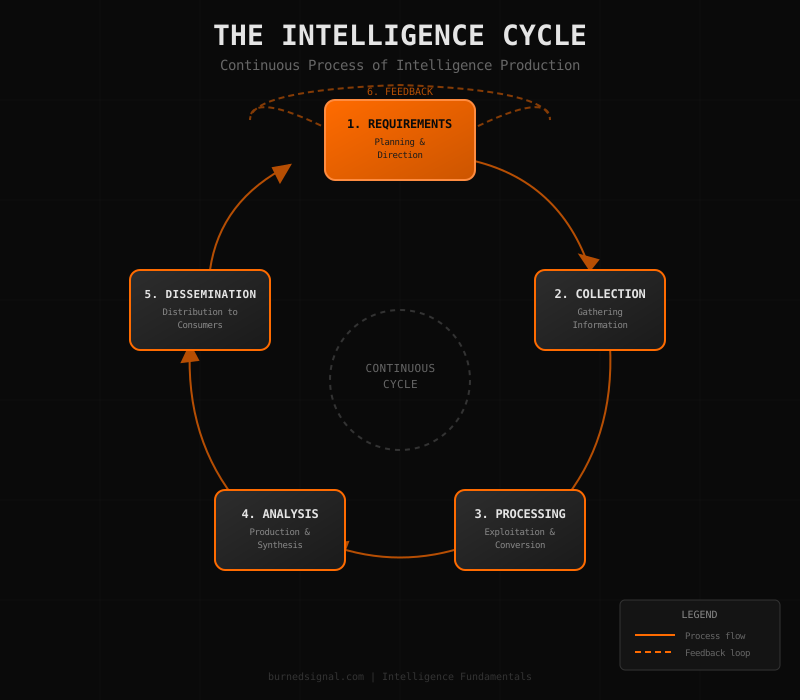
Phase 1: Requirements (Planning & Direction)
Intelligence begins with a question. Requirements define:
- Priority Intelligence Requirements (PIRs): Critical questions leadership needs answered
- Essential Elements of Information (EEIs): Specific data points needed to address PIRs
- Collection emphasis: Which INTs to prioritize
- Intelligence Gaps: What we don’t know but need to know
Example PIR: “What are the most likely threat actors to target our organization in the next 12 months, and what TTPs do they employ?”
Common Failure Point: Requirements that are too vague (“tell me about threats”) or too narrow (missing emerging threats).
Phase 2: Collection
Systematic gathering of raw information using appropriate INTs. Effective collection:
- Aligns with defined requirements
- Employs multiple INTs for corroboration
- Documents sources and methods
- Maintains chain of custody
- Identifies collection gaps
Collection Management involves prioritizing limited collection assets against numerous requirements. Not everything can be collected—tradeoffs are necessary.
Phase 3: Processing (Exploitation)
Raw collected material is converted into usable form:
- Translation
- Decryption
- Format conversion
- Data normalization
- Deduplication
- Initial validation
- Source evaluation
Phase 4: Analysis (Production)
The intellectual core of intelligence work. Analysis involves:
- Correlation of multiple sources
- Pattern recognition
- Hypothesis development and testing
- Application of Structured Analytical Techniques (SATs)
- Assessment of reliability and credibility
- Confidence level assignment
- Production of finished intelligence products
Analytical Rigor: Professional analysis employs SATs to mitigate cognitive biases and ensure defensible conclusions. An assessment without a confidence level and supporting reasoning is an opinion, not intelligence.
Phase 5: Dissemination
Finished intelligence must reach consumers in appropriate formats and through secure channels:
- Written reports (assessments, briefings)
- Alerts and notifications
- Machine-readable feeds (STIX/TAXII)
- Dashboards and visualizations
- Oral briefings
Key Principle: Intelligence that doesn’t reach the right person at the right time is useless, no matter how accurate.
Phase 6: Feedback (Evaluation)
Consumers provide feedback on:
- Relevance to their needs
- Timeliness of delivery
- Actionability of recommendations
- Accuracy (over time)
This feedback refines future requirements, completing the cycle.
Attribution: The Confidence Spectrum
Attribution—determining who is responsible for an action—is one of the most challenging aspects of intelligence work, particularly in the cyber domain.
Why Attribution is Hard
| Challenge | Description |
|---|---|
| False Flags | Adversaries deliberately plant evidence pointing to others |
| Shared Tooling | Multiple actors use the same malware families (Cobalt Strike, Mimikatz) |
| Proxy Operations | Contractors, criminals-for-hire obscure true sponsors |
| Infrastructure Overlap | Shared hosting, bulletproof providers, compromised systems |
| Parallel Development | Similar TTPs may emerge independently |
| Deliberate Confusion | APT28 vs APT29 have overlapping operations |
Attribution Confidence Levels
| Level | Description | Basis |
|---|---|---|
| HIGH | We assess with high confidence… | Multiple independent sources, corroborating evidence across INTs, consistent with known patterns |
| MODERATE | We assess with moderate confidence… | Good evidence from fewer sources, some analytical gaps, generally consistent |
| LOW | We assess with low confidence… | Limited evidence, significant gaps, plausible but uncertain |
Critical Point: Even “HIGH confidence” is not certainty. The 2002 Iraq WMD NIE assessed with “high confidence” that Iraq had WMD programs—and was wrong.
Attribution in Practice
Real-world attribution rarely produces clear answers:
Example - Better Attribution Statement:
“We assess with MODERATE confidence that APT29 is responsible for this intrusion, based on: (1) infrastructure overlap with previously attributed APT29 operations, (2) TTP consistency with documented APT29 playbooks, and (3) targeting alignment with Russian strategic interests. However, we cannot exclude the possibility of a sophisticated false flag operation, shared tooling, or contractor involvement. Alternative hypotheses considered include APT28 and criminal actors with Russian nexus.”
This is more honest—and more useful—than simply saying “APT29 did it.”
Application to Cyber Threat Intelligence (CTI)
The traditional intelligence framework maps directly to cyber threat intelligence:
| Traditional Concept | CTI Application |
|---|---|
| PIRs | “What ransomware groups target our sector?” |
| HUMINT | Dark web forum engagement, insider threat programs |
| SIGINT | Network traffic analysis, C2 protocol research |
| OSINT | Threat actor blogs, paste sites, code repositories |
| GEOINT | Infrastructure geolocation, data residency compliance |
| Source Evaluation | Threat feed quality assessment, indicator confidence |
| Intelligence Cycle | CTI program operations |
| Cognitive Biases | Analyst training, structured analysis |
The Pyramid of Pain
David Bianco’s Pyramid of Pain (2013) illustrates the relationship between indicator types and the cost to adversaries when those indicators are denied:
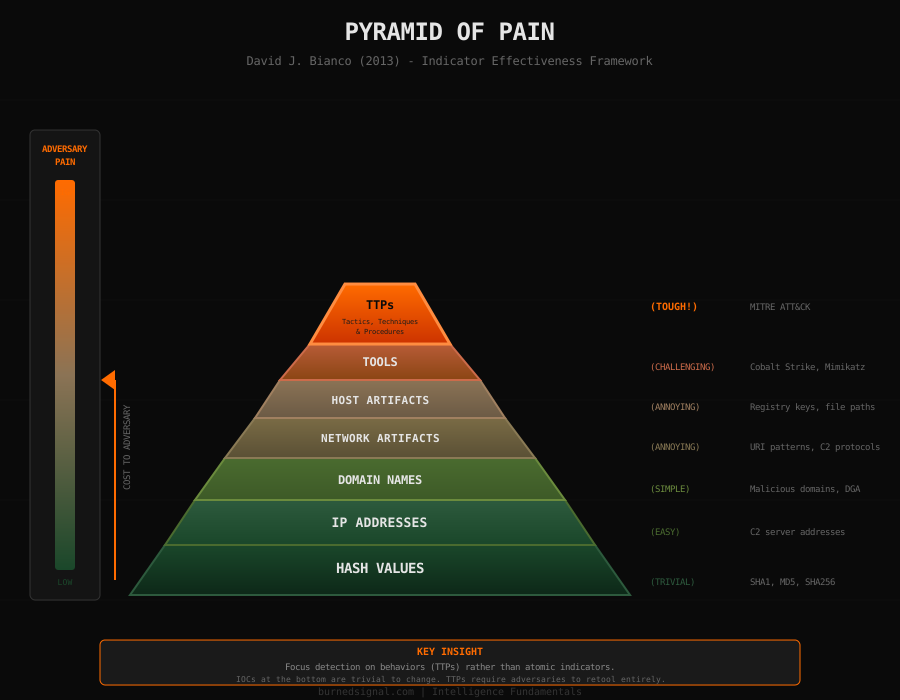
| Level | Indicator Type | Adversary Pain | Notes |
|---|---|---|---|
| Top | TTPs | TOUGH! | Must change behavior, tradecraft |
| Tools | Challenging | Must find/develop new tools | |
| Host Artifacts | Annoying | Registry keys, file paths, mutexes | |
| Network Artifacts | Annoying | URI patterns, C2 protocols, JA3 | |
| Domain Names | Simple | DNS is cheap, but requires setup | |
| IP Addresses | Easy | Infrastructure is fungible | |
| Bottom | Hash Values | Trivial | Recompile = new hash |
Key Insight: Organizations that focus detection on Tactics, Techniques, and Procedures (TTPs) rather than atomic indicators create significantly higher costs for adversaries. This aligns with the MITRE ATT&CK framework’s behavior-based approach.
Case Study: From Data to Intelligence
Let’s trace how raw data becomes actionable intelligence through proper analytical process:
The Data
timestamp: 2024-11-15T03:42:17Z
src_ip: 192.168.1.105
dst_ip: 45.33.32.156
dst_port: 443
bytes_out: 2847
bytes_in: 156892
The Information
- Source: Workstation WS-105 (Finance, user: john.doe)
- Destination: IP geolocated to St. Petersburg, Russia
- Provider: VPS provider with documented abuse history
- Time: 03:42 UTC (non-business hours for US East Coast)
- Traffic pattern: Small request, large response (possible exfiltration or beacon check-in)
Analysis Process
Step 1: Source Evaluation
- Network telemetry: A1 (our own sensors, raw data)
- Threat intel on destination IP: B2 (reputable vendor, not independently confirmed)
- ISAC reporting: C2 (peer reports, limited detail)
Step 2: Hypothesis Generation
- Malicious C2 communication (APT)
- Malicious C2 communication (criminal)
- Legitimate but unusual business activity
- Compromised third-party application
- False positive (CDN, cloud service)
Step 3: Evidence Evaluation
| Evidence | H1 (APT) | H2 (Criminal) | H3 (Legit) | H4 (Third-party) | H5 (FP) |
|---|---|---|---|---|---|
| Russian IP | ++ | + | - | N | N |
| Non-business hours | + | + | - | N | N |
| Traffic pattern | ++ | ++ | N | + | - |
| Prior spearphish | ++ | + | – | N | – |
| ISAC correlation | ++ | N | – | N | – |
| Finance dept targeting | ++ | + | N | N | N |
Step 4: Assessment
After applying ACH methodology:
We assess with MODERATE confidence that this activity represents command-and-control communication by a sophisticated threat actor, likely APT29 or affiliated entity. This assessment is based on: infrastructure correlation with previously attributed operations (B2), TTP consistency with documented nation-state playbooks, targeting alignment with economic espionage objectives, and corroborating activity reported by sector peers.
Alternative hypotheses: Criminal actor (possible but less consistent with targeting), compromised third-party software (requires additional investigation).
Key assumptions: Threat intelligence attribution of destination IP is accurate; spearphishing email was the initial vector.
Intelligence gaps: No malware sample recovered; limited visibility into lateral movement.
The Wisdom
Recommendations:
- Initiate incident response procedures (HIGH priority)
- Preserve forensic evidence for potential law enforcement engagement
- Engage legal counsel regarding nation-state attribution implications
- Coordinate with sector ISAC (share indicators, request additional context)
- Brief executive leadership on potential business impact
- Expand detection for related TTPs across enterprise
- Review third-party applications with Finance access
Looking Ahead
This foundational piece establishes the conceptual framework for intelligence operations. Subsequent articles in this series will provide deeper dives:
- Part 1: OSINT Deep Dive — Sources, Tools, Tradecraft, and Legal Considerations
- Part 2: SIGINT Fundamentals — From RF to Packet
- Part 3: HUMINT in Cyber Operations — Social Engineering and Beyond
- Part 4: GEOINT for Cyber — Physical-Digital Convergence
- Part 5: Structured Analysis — ACH, Red Teaming, and Cognitive Bias Mitigation
Glossary
| Term | Definition |
|---|---|
| ACH | Analysis of Competing Hypotheses - structured technique for evaluating multiple explanations |
| COMINT | Communications Intelligence - subset of SIGINT |
| CTI | Cyber Threat Intelligence |
| EEI | Essential Elements of Information |
| ELINT | Electronic Intelligence - subset of SIGINT |
| FININT | Financial Intelligence |
| GEOINT | Geospatial Intelligence |
| HUMINT | Human Intelligence |
| I&W | Indicators and Warnings |
| IMINT | Imagery Intelligence |
| INT | Intelligence discipline |
| IOC | Indicator of Compromise |
| ISAC | Information Sharing and Analysis Center |
| MASINT | Measurement and Signature Intelligence |
| OSINT | Open Source Intelligence |
| PIR | Priority Intelligence Requirement |
| SAT | Structured Analytical Technique |
| SIGINT | Signals Intelligence |
| SOCMINT | Social Media Intelligence |
| TECHINT | Technical Intelligence |
| TTP | Tactics, Techniques, and Procedures |
References and Further Reading
Official Publications
- Joint Publication 2-0: Joint Intelligence (US DoD)
- Intelligence Community Directive 203: Analytic Standards
- Intelligence Community Directive 206: Sourcing Requirements
- NIST SP 800-150: Guide to Cyber Threat Information Sharing
Foundational Texts
- Heuer, R. (1999). Psychology of Intelligence Analysis — Essential reading on cognitive biases
- Lowenthal, M. (2019). Intelligence: From Secrets to Policy — Comprehensive overview
- Clark, R. (2019). Intelligence Analysis: A Target-Centric Approach — Modern analytical methods
Historical Case Studies
- Wohlstetter, R. (1962). Pearl Harbor: Warning and Decision — Classic study of intelligence failure
- Jervis, R. (2010). Why Intelligence Fails — Analysis of Iraq WMD assessment failure
CTI-Specific Resources
- MITRE ATT&CK Framework: https://attack.mitre.org
- Bianco, D. (2013). The Pyramid of Pain: https://detect-respond.blogspot.com/2013/03/the-pyramid-of-pain.html
- STIX/TAXII Standards: https://oasis-open.github.io/cti-documentation/
- FIRST Traffic Light Protocol: https://www.first.org/tlp/
This article is part of the Intelligence Fundamentals series. The series aims to bridge traditional intelligence tradecraft with modern cyber threat intelligence operations.
Questions, corrections, or feedback? Open an issue on GitHub or reach out via the contact page.
Changelog:
- v1.1: Added Source Evaluation section, Cognitive Biases section, Attribution Confidence Levels, expanded Legal/Ethical considerations, corrected Pyramid of Pain structure, added Glossary
- v1.0: Initial release